
Last updated November 15, 2026
 Wrought iron
 Wood & steel frame
 Farm & ranch
 Sliding driveway gates
 LiftMaster operators
Free on-site gate assessment - hinges, posts, and your LiftMaster or Nice gate operator checked before anything is quoted
The assessment is free and the quote is the invoice.
Get your free estimateDIY vs Professional Gate Repair: The Gresham Homeowner’s Decision Guide
Replacing a remote battery is DIY. Adjusting the close-force pressure on a hydraulic swing gate is not. The line between them is more precise than most homeowner guides admit, and it rarely has anything to do with how handy you are. The decision hinges on which component failed, what kind of energy or voltage sits behind it, and whether the repair touches the safety systems that keep a moving gate from hurting someone.
We’re a gate repair company, so you’d expect us to say call a professional for everything. We won’t. Some tasks are genuinely safe and reversible for a careful homeowner, and telling you otherwise wastes your money. What we can do is draw the line clearly. By the end of this guide you’ll know exactly which repairs belong on your side of it and which ones belong on ours.
This guide is written for Gresham homeowners and property managers dealing with real driveway and access gates in real weather, with a straight answer on each component.
Quick Answer
It depends entirely on the component. Batteries, remote pairing, visual sensor alignment, track clearing and light lubrication are safe DIY tasks for a careful homeowner. Control boards, motors, hydraulic systems, any 120-volt wiring, and anything that changes the gate’s force or safety sensing require a trained technician, because those repairs involve stored energy, electrical code and UL 325 compliance. If the repair changes how the gate moves, stops, or reverses, treat it as professional work.
Styles & brands we work with
- Wrought iron
- Wood & steel frame
- Farm & ranch
- Sliding driveway gates
- LiftMaster operators
Table of Contents
- The Component-by-Component DIY Eligibility Chart
- What You Can Safely Do Yourself
- What Requires a Trained Technician
- UL 325, Liability, and Oregon’s Insurance Reality
- The Tools That Make Most DIY Attempts Fail Early
- How to Handle a Gate Emergency Safely
- Three Repairs That Look Easy on YouTube
- Why Gresham Conditions Change the Decision
The Component-by-Component DIY Eligibility Chart
Here’s the practical way to sort this. Look at what actually broke, not at how the whole gate is behaving. A gate that won’t open could have five different root causes, and some of them are yours to fix while others are not.
The chart below is the map. Anything in the left column you can reasonably handle with basic tools and no risk to yourself or the gate’s safety systems. Anything in the right column needs a trained technician, because the risk isn’t just a bigger repair bill. It’s injury or a gate that no longer complies with the safety standard it was built to meet.
| Component / Task | DIY Safe? | Why |
|---|---|---|
| Remote battery replacement | Yes | No stored energy, fully reversible, no wiring exposed. |
| Pairing a new remote to the operator | Yes | Follows the operator’s manual; a mis-pair is easily undone. |
| Visual inspection of the gate path | Yes | Look, don’t touch. Clears debris, flags problems early. |
| Light lubrication of hinges and rollers | Yes | No powered components involved, low risk. |
| Photoelectric sensor alignment (repositioning only) | Yes, if unpowered | Re-aim only. Rewiring the sensor is not DIY. |
| Clearing a stuck track of debris | Yes | Mechanical obstruction removal with power off. |
| Control board diagnosis or replacement | No | Low-voltage logic still needs the right board and correct wiring. |
| Motor or operator replacement | No | Stored mechanical energy, gear systems, load ratings. |
| Hydraulic swing gate pressure adjustment | No | Changes close-force and safety behavior directly. |
| Any 120-volt wiring or power run | No | Electrical code, permit, and shock hazard. |
| Safety edge and reversing sensor wiring | No | UL 325 compliance depends on it functioning correctly. |
| Hinge replacement or post reinforcement | No | Structural load and crushing risk on heavy panels. |
Print that chart or screenshot it. It answers the question for most Gresham homeowners before they even pick up the phone, and it saves a service call when the answer really is “swap the battery.”
What You Can Safely Do Yourself
The tasks that belong to you share three traits: they’re low voltage or no voltage, they’re fully reversible, and they don’t change how the gate moves or senses obstacles. Here’s what that looks like in practice.
- Battery and remote work. Remote batteries, keypad batteries, and pairing a fresh remote to your operator. If your gate is a DoorKing or LiftMaster residential unit, the manual walks you through pairing and it’s a five-minute job.
- Visual diagnostics. Walk the gate path with the power off. Look for debris, a bent arm, a sagging panel, a spread in the track, or a loose hinge. You don’t need to fix anything to spot it, and a clear observation helps a technician get to the right diagnosis faster.
- Clearing obstructions. With power off, clear leaves, gravel, snow, or a dropped branch from the track or swing arc. A surprising share of “dead gate” calls are really “something is jammed in the way.”
- Light lubrication. Hinges, rollers and pivot points appreciate a little light grease or spray lubricant. Heavy grease attracts grit and does more harm in a wet climate.
- Repositioning photoelectric sensors. If a sensor has been knocked out of aim by a bump or a dog, moving it back into alignment is fine. Rewiring it is not.
Notice what’s missing. None of this touches the operator’s electronics, the motor, the hydraulics, or the safety circuitry. That’s the dividing line, and it’s consistent across every brand we work on, from a Mighty Mule on a rural driveway to commercial-grade FAAC systems on managed properties.
What Requires a Trained Technician
On the other side of the line sit the repairs that involve stored energy, live voltage, or the safety systems that stop a moving gate when something is in the way. These aren’t hard because the components are exotic. They’re hard because getting them wrong is dangerous and because the fix has to return the gate to a safe, compliant state, not just a “it moves again” state.
Control boards are a good example. A board swap looks like plugging in a new part, but the board has to match the operator, the accessories wired to it, and the safety inputs. Put the wrong board in and the gate may run but the reversing sensors may not trip when they should. That’s worse than a gate that won’t move at all.
Hydraulic systems are another. Adjusting close-force pressure changes how hard the gate pushes before it reverses. Too high and the gate can cause injury. Too low and wind or a slight grade stalls it. Setting that correctly is a measurement job, not a guess.
Electrical connections are the clearest no. Any 120-volt power run, any hardwired operator, any safety edge wiring lives on the electrician-and-permit side of the line. Gresham gets wet, and a marginal connection in a control box is a fault waiting for the next stretch of rain.
Finally, heavy swing and slide panels. Replacing a hinge or reinforcing a post means holding the weight of a panel that can crush a hand or a foot the moment it slips. The gate has no torsion springs, so this isn’t the garage-door risk profile, but the crushing risk on a heavy panel is real and worth respecting.
UL 325, Liability, and Oregon’s Insurance Reality
UL 325 is the safety standard for automatic gate operators in the U.S. It covers things like entrapment protection, reversing sensors, and the requirements a powered gate has to meet to be considered safe. It matters to a homeowner’s decision here because it isn’t just about the gate working. It’s about what happens if the gate causes injury.
When you repair an automatic gate yourself, you carry the liability for that repair. If a gate you serviced later fails to reverse on a person or a vehicle, the insurance company’s investigation starts with the service history and the state of the safety systems. A repair that bypassed or altered the reversing sensing, or that used the wrong part for the operator, is exactly the kind of thing that shifts liability onto the person who did the work.
For Oregon property managers and small business owners, this is a bigger deal than it looks. A commercial access gate used by tenants or customers that injures someone is a liability and compliance problem at once. Having the service history and the safety system checked by a technician is what makes the property defensible, not a nice-to-have.
We’re not lawyers and we can’t promise how any insurer will treat a given case. But in our experience, the difference between a DIY repair and a technician repair shows up in the record. A written estimate and a documented service visit is a very different paper trail than a memory of “I replaced the board myself.” When you have a technician work on an automated gate, the visit also covers UL 325-relevant safety checks, so the gate leaves the visit safe, not just functional. If you’re not sure whether your gate’s safety systems are intact, that’s a reason to electric gate repair on the record rather than a weekend project.
The Tools That Make Most DIY Attempts Fail Early
Most failed DIY gate repairs don’t fail because the homeowner lacked skill. They fail because the job needs tools the homeowner doesn’t own, and improvisation with substitutes causes a second, more expensive failure. Here’s the honest inventory.
- A multimeter. Control-side diagnostics start with checking voltage and continuity. Without one, board and sensor faults are guesswork.
- Manufacturer-specific boards and parts. Boards aren’t universal. The right part for a DoorKing operator isn’t the right part for a LiftMaster, and the wrong board can run a gate with the safety sensors dead.
- Force-test equipment. Ordering a gate’s close-force correctly means measuring the force it applies, not adjusting by feel until it seems right.
- Torque tools and lifting equipment. Panels and posts need proper torque, and heavy panels need safe lifting and blocking.
- Voltage-rated tools and PPE. Anything that touches 120-volt wiring needs the right insulation and safety gear, plus the permit to do the work.
- Diagnostic software and troubleshooting manuals. Many modern operators log fault codes that need the right reference to decode. Without them, “won’t open” stays a mystery.
That list is why so many gate repairs that start as DIY end up as service calls, sometimes after a part has been ordered twice. We’ve watched a lot of these come through the door, and the pattern is consistent.
How to Handle a Gate Emergency Safely
A gate stuck open or stuck closed is frustrating but not urgent in the way a fire is urgent. The priority is keeping people and vehicles safe while the gate is out of order, then getting it fixed without making it worse. Here’s how to handle it.
- Stop operating the gate. Don’t fight it with the remote. Every cycle a stuck gate runs puts strain on a motor, arm or mechanism that’s already struggling and turns a small repair into a bigger one.
- Cut power at the operator’s disconnect or breaker. Confirm the gate isn’t moving before you go anywhere near the panel.
- Use the manual release only if the gate is safe to move. Most powered gate operators have a manual release, but a heavy swing or slide gate that’s released out of position can move with force. Block it, secure it, and only release when you’re clear of the gate’s path.
- Secure the opening. A stuck-open gate leaves a driveway or property open. Block the opening with a vehicle, cones or a temporary barrier until you can get it fixed, especially for commercial property managers.
- Never prop a gate against something moving. Don’t put a rock or a wedge in the path of a gate that might suddenly power on or get a signal. Secure the gate, not the obstruction.
- Call for repair. Call (866) 942-6384. We answer 24/7. Fast dispatch from 7am to 7pm, Sunday through Friday. A call outside dispatch hours is booked into the next opening.
What not to do in the meantime: don’t climb over or around a powered gate, don’t attempt to override the safety sensors to get it moving, and don’t hold down the remote to keep pushing a stalled gate. Those are the actions that turn a repair call into an injury.
Three Repairs That Look Easy on YouTube
Every gate technician has a set of repairs that arrive regularly because a video made them look simple. Here are the three we see most often, and why the video left out the important part.
1. Adjusting the limit switches. The video shows someone nudging a limit switch until the gate opens the right distance, and the gate looks fixed. What the video doesn’t show is that nudging the limit switch without checking the rest of the system can leave a gate opening too far, straining the arm or allowing the panel to over-travel. By the time it arrives for repair, the operator has taken extra wear it didn’t need to.
2. “Resetting” the control board by jumping terminals. This shows up constantly on older operators. Jumping a board to force a cycle can get a stuck gate moving once, but it bypasses the safety inputs and can short a board or a sensor. Homeowners in Gresham who’ve tried this often end up with a dead board on top of the original problem, which is a bigger repair than the original.
3. Replacing a sensor you think is bad. Sensor faults are often wiring, alignment, or a dirty lens, not a failed sensor. A new part installed on the wrong wiring changes nothing and adds cost. We’ve seen this pattern on everything from budget Mighty Mule units to commercial systems, and it’s one of the most common “fix the fix” cases in the local market.
The rule of thumb: if the video involves a jumper wire, a force test, or bypassing a safety input, stop and call. That’s the point where DIY stops being reversible.
Why Gresham Conditions Change the Decision
Gresham’s weather matters to the DIY decision in a few concrete ways. The rainy months and the late-winter wind gusts push on gates differently than dry and calm weather. Wet hinges, swollen wooden panels, and water-saturated tracks all change how much force a gate needs to move, and a repair made in July may behave very differently in January.
That’s why “adjust it until it works” is a poor method locally. A gate that’s been tuned tight against a dry track can stall when the track swells with moisture, and a gate that’s been tuned loose for summer can slam in a gust. A technician sets the force and the limits with those conditions in mind, and checks the sensors aren’t tripped by the seasonal grade changes that come with wet ground.
Rain also finds its way into control boxes and into the low-voltage wiring on safety sensors. That’s the component range where water intrusion does the most damage and where a professional gate repair visit catches a failing seal before a board fails. If your gate is in a neighborhood like Centennial, Rockwood or Powellhurst-Gilbert with mature trees and heavy leaf fall, clearing the track is one DIY task worth doing regularly. The rest of the list is what we’re here for.
Neighborhood aside, the same single decision applies across the Gresham area: identify the component, check it against the chart above, and call when it lands on the technician side.
Common Mistakes to Avoid
- Treating every gate fault as an operator fault. A gate that won’t open is usually a power, sensor, wiring or obstruction issue before it’s a motor issue. Check the simple causes before assuming the operator is dead.
- Overriding a safety sensor to “test” the gate. Bypassing the reversing sensing to get the gate moving is the single most dangerous DIY move in the workflow. It can kill someone, and it’s not worth a moment’s convenience.
- Using the wrong replacement part. Boards and sensors aren’t interchangeable between brands. A board that fits physically can still fail the safety check on your specific operator.
- Adjusting close-force by feel. Hydraulic and force adjustments have to be measured against the gate’s requirements, especially on heavy residential and commercial swings. Guesswork here is a liability question, not just a function question.
- Keeping the gate running while it’s stuck. Every extra cycle on a stalled gate adds wear to the motor, arm or mechanism. Stop operating it and get it diagnosed.
- Ignoring wet-season issues during dry-season tune-ups. In Gresham’s wet months, a gate tuned for a dry track can stall or bind. Set and test with the season in mind.
- Skipping the paper trail on a commercial property. For property managers in Gresham, a documented service visit and a written estimate is what makes the safety repair defensible if anything later goes wrong.
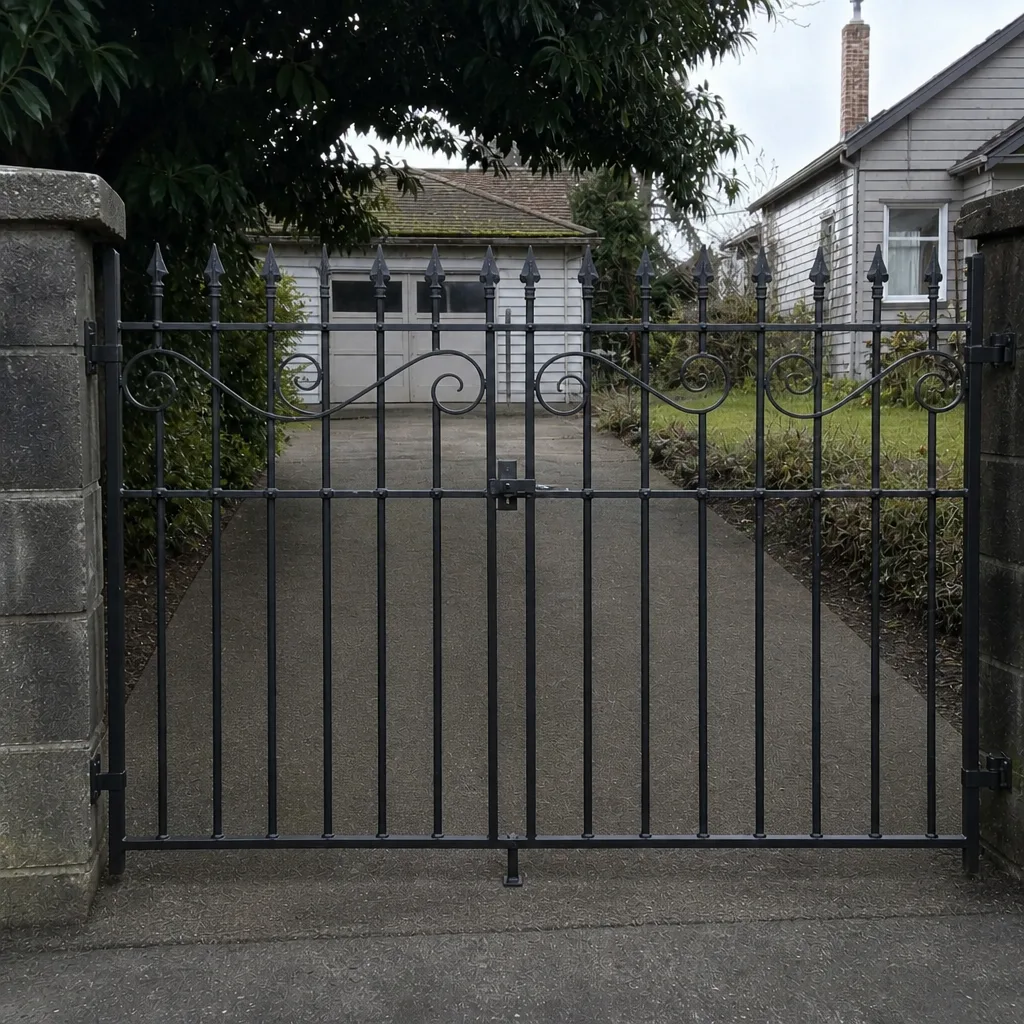
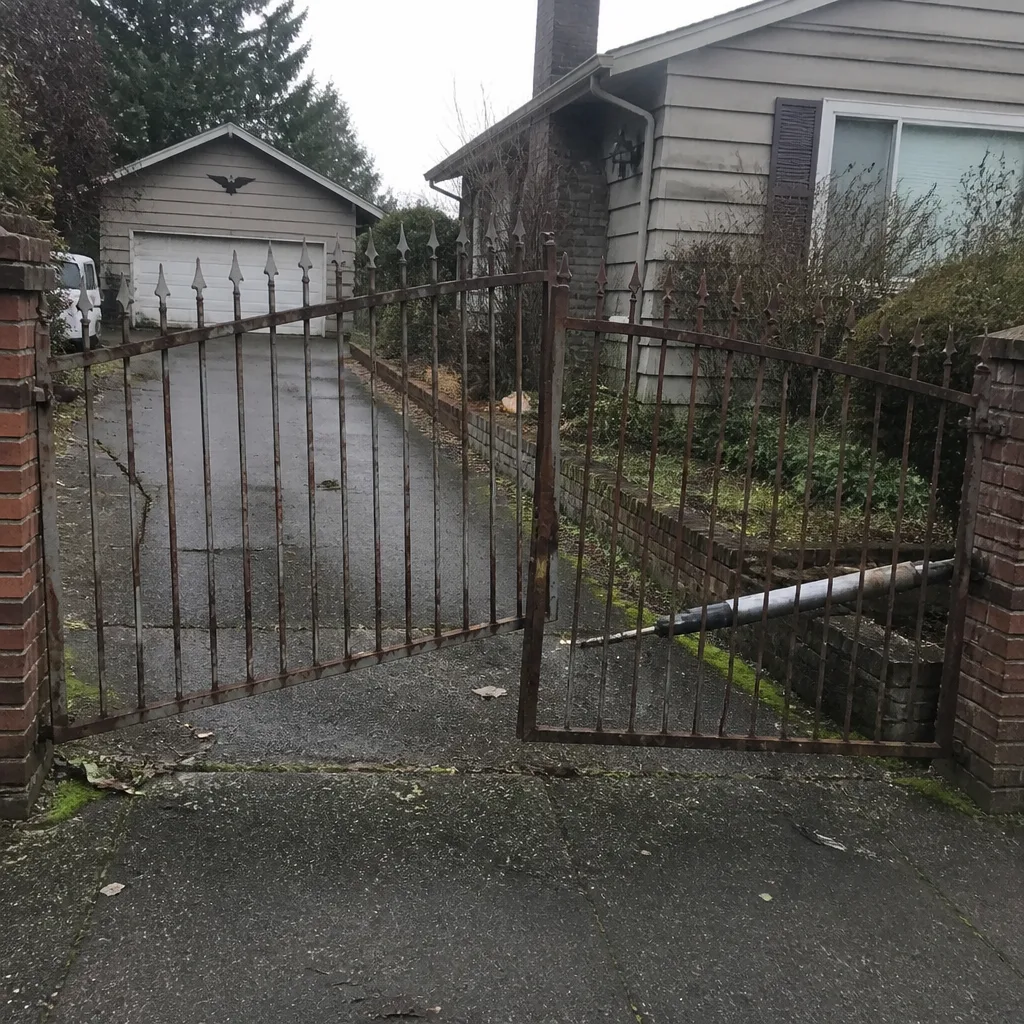
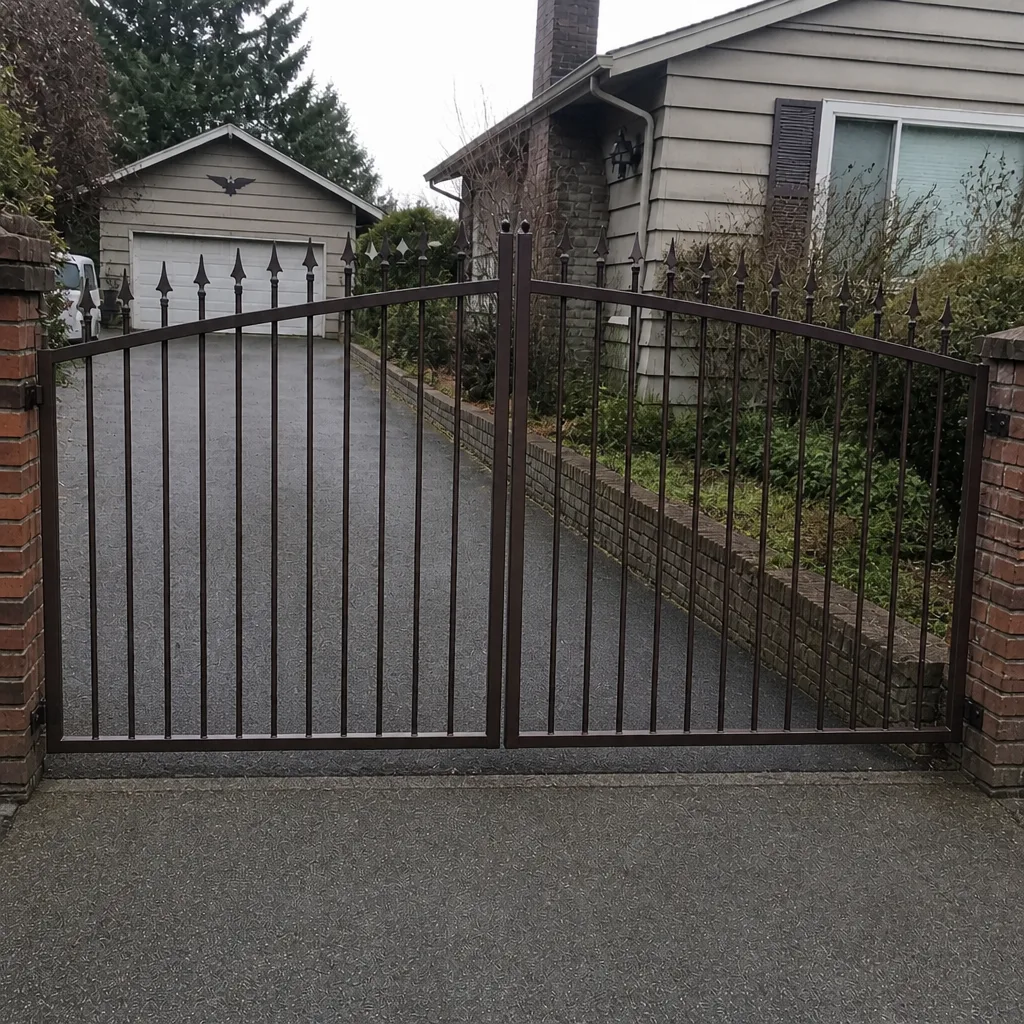
See the difference
 Before
 After
 Before
 After
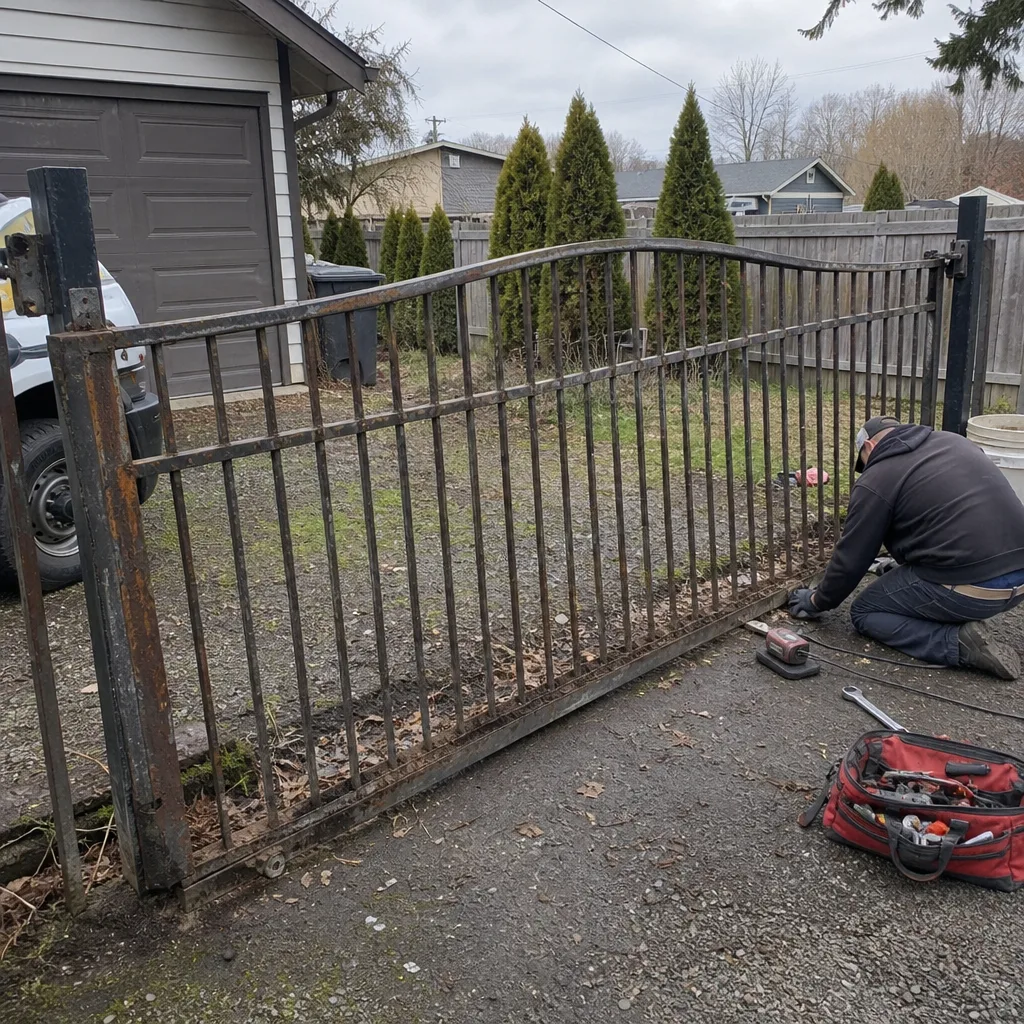 Before
 After
When to Call a Professional
Call a technician when the repair touches a control board, motor, operator, hydraulic system, any 120-volt wiring, safety sensor wiring, or any structural panel or post work. Call when the gate reverses incorrectly, when the safety sensors trip repeatedly, when the gate stalls or runs past its limits, or when a repair you attempted has made it worse. Call if you’re a property manager who needs a documented service history on an access gate. And call if you simply want the gate checked against UL 325-relevant safety systems after a repair, because that check is part of the technician’s job and is not something a homeowner can self-certify.
Gate Repair Gresham offers free estimates in Gresham. Call (866) 942-6384. We answer 24/7. Fast dispatch from 7am to 7pm, Sunday through Friday. Our technicians have up to 8 years of experience, and we work on nearly every major gate brand, including yours.
Frequently Asked Questions
You can safely handle the non-powered, reversible tasks: remote batteries, remote pairing, visual inspection, clearing obstructions, and light lubrication. Anything involving the control board, motor, hydraulics, 120-volt wiring, or the safety sensors needs a trained technician, because those repairs affect the gate’s safety systems and UL 325 compliance. If the repair changes how the gate moves, stops, or reverses, treat it as professional work.
UL 325 is the safety standard for automatic gate operators in the U.S., covering entrapment protection and reversing safety. It matters because a self-performed repair that alters or bypasses the safety systems leaves you carrying the liability if the gate later injures someone. In Oregon, property managers and business owners face a bigger consequence, since an access gate that injures a tenant or customer is both a safety and a liability problem. Call (866) 942-6384 for an exact quote on having a technician check your gate’s safety systems, estimates are free.
Stop operating the gate, cut power at the operator’s disconnect or breaker, and secure the opening with a barrier or vehicle until you can get it repaired. Don’t put a wedge in the gate’s path or climb over a powered gate. Call (866) 942-6384. We answer 24/7. Fast dispatch from 7am to 7pm, Sunday through Friday. A call outside dispatch hours is booked into the next opening.
We work on nine of the most widely installed gate brands, including LiftMaster, DoorKing, Elite, Mighty Mule, FAAC, BFT, Linear, Viking and Ghost Controls. That range covers budget residential operators and commercial access systems, so we can diagnose nearly any system you already own rather than pushing you toward a replacement.
Gate repair pricing is set per job by the written estimate, and the price is quoted and agreed before any work starts. That means the number you agree to is the number you pay, and there’s no invoice surprise afterward. The estimate itself is free. Call (866) 942-6384 for an exact quote on your gate.
Usually not, though the cause determines it. If the gate path has an obstruction or a sensor lens is dirty or misaligned, clear and clean it first. If it still won’t close, the cause is likely a sensor fault, a wiring issue, or a control board problem, all of which need a technician. Call (866) 942-6384 for an exact quote, estimates are free.
The Bottom Line
The DIY vs professional decision isn’t a judgment on the homeowner. It’s a judgment on the component. Batteries, remotes, visual inspection, light lubrication and clearing the path are yours to handle. Control boards, motors, hydraulics, 120-volt wiring and safety sensors belong to a trained technician, and once safety systems are in play, the repair also affects your liability. In Gresham, seasonal rain and wind make force and limit adjustments a measurement job, not a feel test. When the repair crosses that line, call. Gate Repair Gresham offers free estimates and specialized, gate-only service, so you’re calling a company that does this every day. Call (866) 942-6384. We answer 24/7. Fast dispatch from 7am to 7pm, Sunday through Friday.
Whether you’re replacing a gate or just trying to keep the one you have moving, start at Gate Repair Gresham. It covers gate repair, electric gate repair, and gate installation from a single point of contact.
Written by the team at Gate Repair Gresham.